SouthPark vs. South End
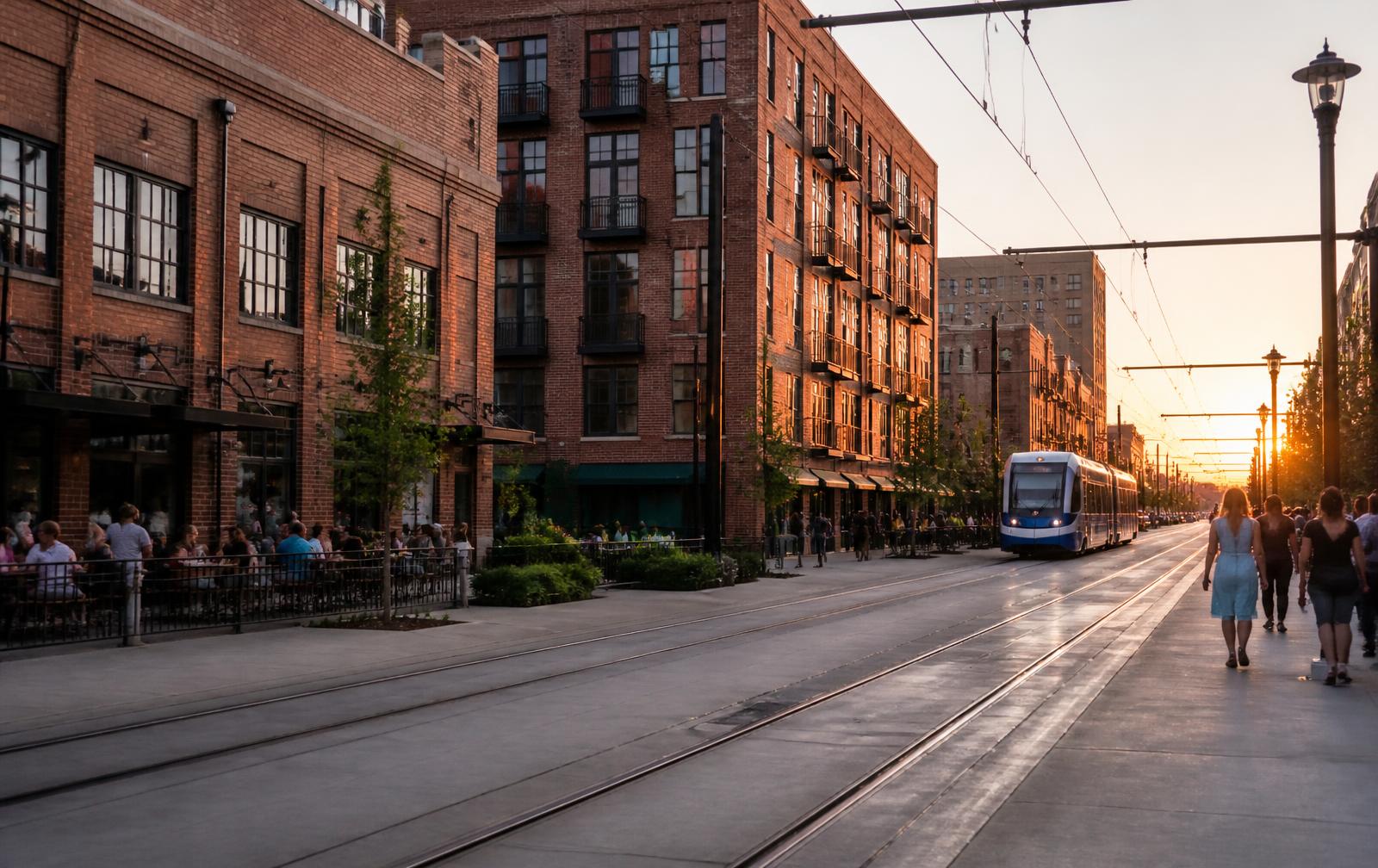
South End is Charlotte's transit-oriented redevelopment story: a former industrial corridor rebuilt around the LYNX Blue Line into dense apartments, breweries, and adaptive-reuse retail. SouthPark is an established mixed district with a regional retail core and mature residential neighborhoods. The gap between them is generational as much as geographic.
Two very different development stories
South End runs southwest of Uptown along the LYNX Blue Line, occupying a corridor that was industrial and warehouse-oriented for most of the twentieth century. Its current form — converted brick warehouses beside new mid-rise apartment blocks, breweries, and street-level retail — is largely the product of transit-oriented redevelopment over the past two decades.
SouthPark developed on a different logic entirely. Postwar residential subdivisions came first; the regional retail core, office buildings, and hotels grew up alongside and among them. The result is an established district with mature canopy and a wide housing range rather than a redeveloping corridor.
One is still becoming what it will be; the other largely already is. That difference shows up in everything from construction noise to price trajectory to who your neighbors are.
Objective comparison
South End in particular changes quickly. Treat this as a structural comparison and verify current specifics before deciding.
| Factor | SouthPark | South End |
|---|---|---|
| Character | Established mixed residential, retail, office and hotel district | Redeveloping transit corridor, adaptive reuse plus new construction |
| Housing available | Detached homes, estate homes, townhomes, condominiums, apartments | Predominantly apartments and condominiums; limited detached housing |
| Typical building age | Mid-century residential with ongoing renovation and infill | Converted early-1900s industrial buildings and recent construction |
| Transit | Bus service; no direct light rail | LYNX Blue Line stations throughout the corridor |
| Walkability | Strong in the core, suburban beyond it | Strong along the rail corridor and the Rail Trail |
| Parking | Mostly free surface and structured parking | Constrained; paid decks and permit-controlled street parking common |
| Retail | Regional shopping destination anchored by SouthPark Mall | Boutique, showroom, design-district and neighborhood retail |
| Dining & nightlife | Polished, reservation-driven, restaurant and hotel bar focused | Breweries, patios, casual-to-mid dining, high turnover of concepts |
| Green space | Neighborhood parks, greenway access, mature tree canopy | Rail Trail linear park; limited mature canopy |
| Typical resident | Families, established households, executives, downsizers | Younger professionals and renters; fewer school-age households |
| Schools | Multiple CMS boundaries; verify by exact address | CMS boundaries apply; fewer family households in the mix |
What each district asks you to give up
South End asks you to accept density, construction, parking friction, and noise in exchange for genuine transit access, walkable nightlife, and a corridor that is still actively adding amenities. Its energy is real; so is the fact that a surface lot next door can become a mid-rise.
SouthPark asks you to accept car dependence outside its core, and retail-driven traffic at peak periods, in exchange for housing-type optionality, mature canopy, established streets, and a settled amenity base that is not going to reinvent itself around you.
There is also a lifecycle pattern worth naming plainly: a meaningful number of Charlotte households live in South End first and move toward districts like SouthPark when they want space or a school boundary. That is not a judgment on either place — it is a common sequence, and knowing where you are in it clarifies the choice.
How to compare cost honestly
Direct price comparison between these districts is unusually easy to get wrong, because the housing products barely overlap. Comparing a South End apartment or new condominium to a SouthPark detached house is a category error; comparing it to a SouthPark condominium is a fair fight.
Where both districts offer condominiums, look past headline price to HOA structure, reserves, parking arrangement, and building age. Adaptive-reuse buildings and new construction carry different maintenance profiles than either mid-century or recent SouthPark stock.
For anything beyond a rough sense of the market, use closed sales within one product type, one defined geography, and one period. Our home values guide explains the segmentation discipline in more detail.
Who each district suits
Choose South End if transit access, walkable nightlife, and being inside a corridor that is still adding restaurants and retail matter more to you than square footage, quiet, or a yard.
Choose SouthPark if you want a wider range of housing types, mature residential streets, easier parking, household-scale errand infrastructure, and school-boundary optionality.
If you are genuinely torn, the deciding question is usually not amenities but housing form: do you want to live in a building or in a house? That answer resolves most of the comparison on its own.
SouthPark vs. South End questions
South End is generally the stronger fit for renters and young professionals who want light rail access, walkable nightlife, and apartment living. SouthPark suits people who want more housing-type choice, easier parking, and a quieter residential setting, and it is also viable for professionals who prefer its condominium and mixed-use inventory.
No. The LYNX Blue Line runs through South End but does not serve SouthPark. Travel between the two districts is by car or bus.
The two are not directly comparable because their housing products differ. Comparing like to like — condominium to condominium — is the only sound approach, and even then building age, HOA structure, and parking arrangements affect total cost of ownership more than headline price does.
Generally no. South End is denser, closer to active rail, and carries more nightlife and construction activity. SouthPark's residential neighborhoods are considerably quieter, though its commercial core sees retail traffic at peak periods.
See the other district comparisons.
SouthPark is most often weighed against Uptown, Myers Park, and Ballantyne. Each guide uses the same objective structure.