SouthPark vs. Dilworth
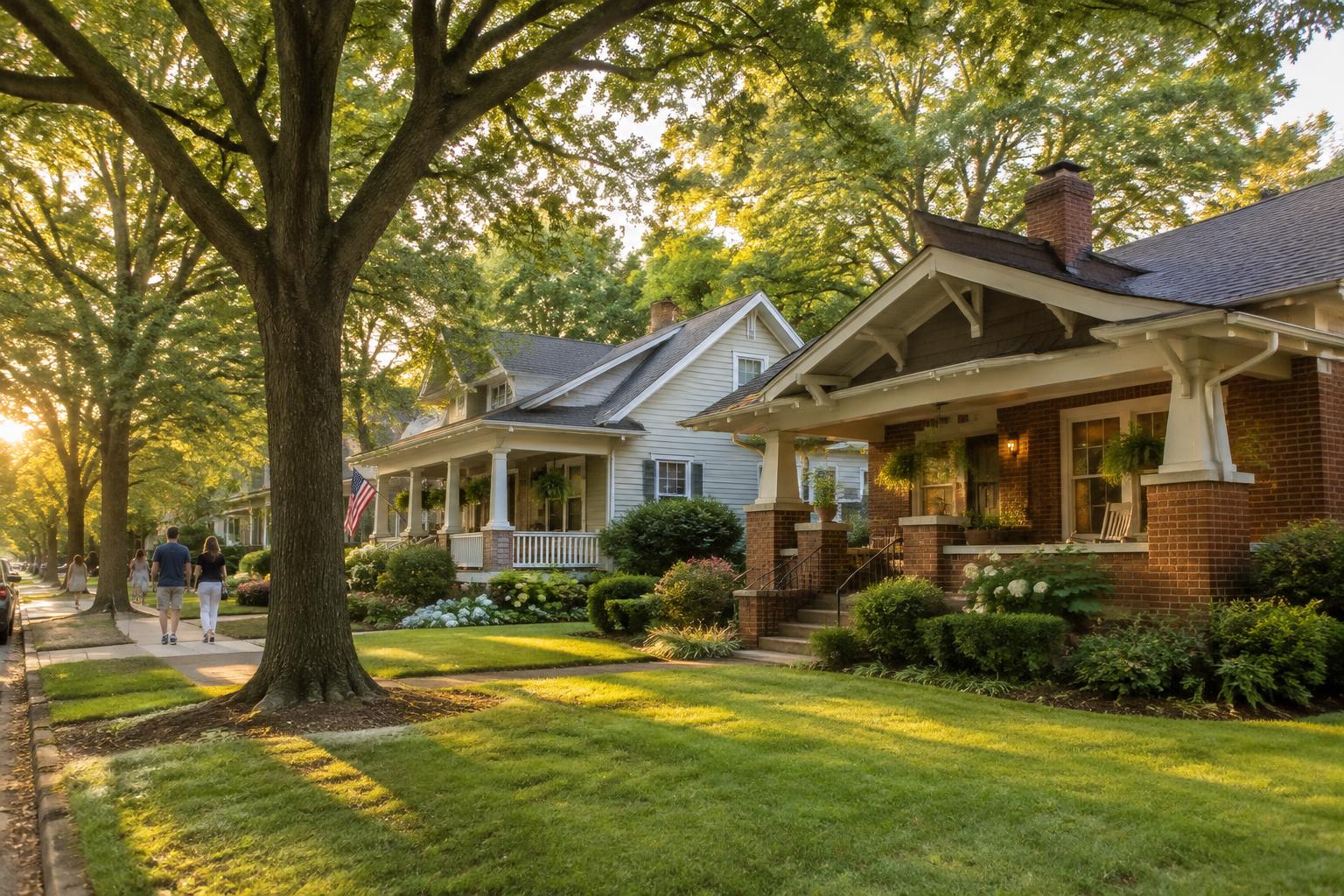
Dilworth is Charlotte's oldest streetcar suburb: early-1900s bungalows and craftsman houses under a mature oak canopy, minutes from Uptown. SouthPark is the city's postwar luxury district: estate lots, mid-century ranches on acreage, and a regional retail core. Relocators weighing Charlotte's top residential addresses almost always compare these two.
Two eras of Charlotte's best residential architecture
Dilworth was platted in the 1890s as Charlotte's first streetcar suburb, roughly a mile south of what is now Uptown. Its housing stock is defined by the era: craftsman bungalows with deep front porches, foursquares, and brick cottages on modest, walkable lots — many now renovated or expanded, some replaced by larger infill homes that must respect the neighborhood's scale.
SouthPark is a product of the postwar decades. Its estate neighborhoods — Foxcroft, Morrocroft, Quail Hollow, Eastover on its edge — were built around space: half-acre to multi-acre lots, long setbacks, and houses designed for privacy rather than porch life. The district grew around SouthPark Mall rather than a streetcar line.
The comparison is really between two definitions of luxury: historic intimacy and porch culture close to the urban core, versus acreage, privacy, and amenity scale in a self-contained district.
Objective comparison
Both neighborhoods command premium pricing. Treat this as a structural comparison and verify current specifics before deciding.
| Factor | SouthPark | Dilworth |
|---|---|---|
| Era & character | Postwar estate district; mid-century ranches, newer estate construction | Charlotte's first streetcar suburb (1890s); craftsman bungalows and foursquares |
| Typical lot size | Half-acre to multi-acre in estate neighborhoods | Compact, often under a quarter-acre |
| Distance to Uptown | About 7 miles; 12–18 minutes by car | About 1 mile; walkable or a few minutes by car |
| Walkability | Strong in the mall/Phillips Place core; car-first in estate neighborhoods | Genuinely walkable throughout — East Boulevard dining, Latta Park, Rail Trail access |
| Retail & dining | Regional luxury retail anchored by SouthPark Mall; polished restaurant scene | Boutique and neighborhood-scale dining along East Boulevard |
| Housing stock | Detached estates, ranches, townhomes, high-rise condominiums | Historic detached homes; limited condo and townhome infill |
| Entry pricing | Condos from the mid-$700Ks; estates from $1.5M to $10M+ | Renovated bungalows commonly $900K–$1.8M; larger infill above $2M |
| Green space | Private lots, Symphony Park, greenway access | Latta Park, Freedom Park on the edge, mature street canopy |
| Renovation reality | Mid-century stock often renovated or rebuilt on large lots | Historic-district oversight shapes exterior changes in designated areas |
| Typical buyer | Households prioritizing space, privacy, and estate amenities | Buyers prioritizing character, porch culture, and Uptown proximity |
What each neighborhood asks you to give up
Dilworth asks you to accept smaller lots, closer neighbors, on-street parking realities, and — in locally designated historic areas — review processes for exterior changes. In return you get one of Charlotte's most beautiful streetscapes, genuine walkability to dining and parks, and a commute to Uptown that barely exists.
SouthPark asks you to accept car dependence outside its commercial core and a longer drive to Uptown. In return you get lot sizes Dilworth cannot offer at any price, quieter streets, easier parking everywhere, and the district's retail and dining infrastructure at your doorstep.
The practical question is where you want your square footage: inside a renovated historic shell on a tight lot near the core, or across a house and grounds with room for a pool, guest house, and garden.
How to compare cost honestly
Price per square foot in Dilworth regularly matches or exceeds SouthPark's estate neighborhoods, because buyers are paying for location and historic character on scarce lots. A $1.5M Dilworth bungalow and a $1.5M SouthPark ranch are fundamentally different products: land and space on one side, walkability and provenance on the other.
In SouthPark, the same budget buys meaningfully more house and lot as you move from the estate core toward walkable enclaves like Barclay Downs and Cotswold. In Dilworth, the premium concentrates on renovated historic homes on the best streets, and unrenovated stock trades at a discount that reflects the cost and oversight of doing the work.
For anything beyond a rough sense of either market, use closed sales within one product type, one defined geography, and one period. Our home values guide explains the segmentation discipline in more detail.
Who each neighborhood suits
Choose Dilworth if you want historic architecture, front-porch street life, walkable dining on East Boulevard, and to be five minutes from Uptown — and you are comfortable trading lot size and easy parking for it.
Choose SouthPark if you want estate-scale lots, privacy, mature canopy without historic-district constraints, a full range of housing types from high-rise condominiums to multi-acre estates, and a self-contained amenity base.
If you are genuinely torn, walk both on a Saturday morning: East Boulevard's sidewalk cafés versus the quiet of a Foxcroft street. Most buyers know which one feels like home within an hour.
SouthPark vs. Dilworth questions
On a price-per-square-foot basis the two are comparable, with Dilworth's renovated historic homes often matching SouthPark estate pricing. SouthPark offers more house and land for the same budget; Dilworth offers location and historic character that money cannot recreate elsewhere.
Dilworth, by a wide margin — roughly one mile, versus SouthPark's seven. Dilworth is walkable or a few minutes by car to the urban core; SouthPark is a 12–18 minute drive.
Both work well. SouthPark offers larger lots, more housing-type choice, and estate amenities; Dilworth offers walkable parks, porch culture, and shorter commutes. School boundaries vary by exact address in both — verify with Charlotte-Mecklenburg Schools.
In locally designated historic areas, exterior changes go through Charlotte's Historic District Commission review, which adds process but protects the streetscape that underpins values. Interior renovation is generally unconstrained. SouthPark's mid-century stock carries no such oversight.
See the other district comparisons.
SouthPark is most often weighed against Myers Park, Uptown, and Ballantyne. Each guide uses the same objective structure.